Most B2B SaaS companies pour budget into driving traffic, then send it to a homepage cluttered with feature lists, navigation menus, and competing CTAs. The result: visitors bounce, CAC climbs, and the sales pipeline stays thin. The fix isn’t more traffic. It’s dedicated landing pages built for one conversion goal at a time. After building over 200 SaaS landing pages at Apexure, for companies ranging from early-stage startups to enterprise platforms, the pattern is clear: SaaS brands that use purpose-built landing pages for each campaign convert 2-5x more visitors than those relying on their website alone. This guide covers the complete B2B SaaS landing page strategy: which page types to build, how to structure them for conversions, and the testing framework that consistently moves the needle.
This guide is written by Waseem Bashir, founder of Apexure, a Clutch Global Award-winning landing page agency. Our team has built conversion-focused SaaS landing pages for companies like Therapy Brands, Flare.io, and CraverApp. Every recommendation here comes from real SaaS campaign data.
B2B SaaS marketing is the discipline of acquiring and retaining business customers for subscription-based software products. Unlike selling a physical product, SaaS marketers face three unique challenges:
Homepage vs. Dedicated landing page, the conversion gap is 2-5x for most SaaS companies. Landing pages solve this by creating a hyper-focused experience for each campaign, audience segment, and funnel stage. Instead of hoping visitors self-move through to the right action, you guide them there.
Working with the Apexure team was a real pleasure. They are very knowledgeable around lead-gen and landing pages, particularly for SaaS companies. Being able to talk through the work and what we were trying to achieve was particularly useful. The quality of what they delivered was first-rate and exactly what we were after.
, Simon Hutton, Gaggle Mail (SaaS) · via UpworkNot all SaaS landing pages serve the same purpose. The page type should match where the buyer is in their journey.
| Page Type | Funnel Stage | Primary CTA | Best For |
|---|---|---|---|
| Free Trial | Mid-funnel | Start Free Trial | Self-serve products, low-touch sales |
| Demo Request | Mid-to-bottom | Book a Demo | Complex products, high-touch sales |
| Competitor Comparison | Bottom-funnel | See Why We're Different | Evaluation stage, switching intent |
| Feature-Specific | Top-to-mid | Try This Feature | PPC campaigns targeting specific pain points |
| Pricing / Plan Selection | Bottom-funnel | Choose Your Plan | Ready-to-buy visitors comparing options |
The lowest-friction conversion path. These pages work best for products that are easy to understand and quick to experience value (time-to-value under 10 minutes).
What works: Minimal form fields (email only or email + name), instant access, clear explanation of what the trial includes. For examples of effective trial pages, see our collection of free trial landing page examples.
When Therapy Brands (TheraNest) needed a landing page for their practice management SaaS, we built an API-integrated page that connected directly to their sign-up system. The page focused on one action, starting a free trial, with feature isolation that marked only the capabilities relevant to the ad the visitor clicked. No feature overload, no navigation distractions.
See exampleAPI-Powered SaaS Landing Page, Therapy Brands→
For complex B2B SaaS products where buyers need a guided walkthrough before committing. These pages need to justify the time investment of a 30-minute call.
What works: Clear articulation of what the demo covers, social proof from similar companies, a qualifying form (4-5 fields), and calendar integration for instant booking.
When Flare.io (cybersecurity SaaS) approached us, their "Book a Demo" pages had too much content and too many distractions. We stripped the page back to essentials, reduced content friction, optimised for mobile, and repositioned the form. Result: doubled demo request conversions. Their 96% customer renewal rate meant every additional demo booking had outsized revenue impact.
For more inspiration, explore our guide to SaaS demo landing pages that make users book instantly.
These target bottom-funnel visitors actively evaluating alternatives. They’re searching terms like “Your Product vs Competitor” and need a structured, honest comparison.
What works: Feature-by-feature comparison table, proof that you win on the dimensions that matter, migration/switching support, and customer testimonials from people who switched. Read our full guide: Competitor Comparison Landing Pages: Tips + Examples for SaaS.
Built for PPC campaigns targeting specific pain points. Instead of sending a “project management tool” ad click to your homepage. You send it to a page that focuses only on the task management feature.
What works: Headline matching the ad keyword, demo/screenshot of the specific feature, results from using that feature, and a CTA to try it.
The final decision page. These need to make plan differences crystal clear and reduce comparison anxiety.
What works: Clean plan comparison, marked “most popular” option, annual vs monthly toggle, FAQ addressing billing concerns, and a money-back guarantee. See our hand-picked collection: Best SaaS Pricing Page Examples.
See exampleSaaS Pricing Page, Conversion-Optimised Layout→
After building 200+ SaaS landing pages, we’ve developed a repeatable framework that consistently lifts conversion rates. Here’s the process:
The Apexure SaaS Landing Page Framework, six phases from ICP definition to testing.
Before designing anything, answer these questions:
SaaS-specific insight: In B2B SaaS, the person evaluating the product (an IC or team lead) is often different from the person who approves the purchase (a VP or finance). Your landing page needs to satisfy both, the evaluator wants features and ease of use, the approver wants ROI and security.
Use this decision framework:
Choose your primary page type based on product complexity, then build supporting pages for each funnel stage.
The single biggest mistake in SaaS landing pages is leading with features instead of outcomes. Visitors don’t care that you have “AI-powered workflow automation with 200+ integrations.” They care that you’ll “Cut their reporting time by 60%.”
"AI-Powered Project Management Platform with Real-Time Collaboration, 200+ Integrations, and Advanced Analytics"
Tells visitors what the product has. Doesn't explain why they should care.
"Ship Projects 40% Faster, Without the Status Meeting Chaos"
Tells visitors what they'll achieve. Features support the claim below the fold.
For a deeper guide to writing conversion-focused copy, see How to Write Landing Page Copy That Gets You More Leads.
SaaS is intangible, buyers can’t try before they buy (unless you offer a trial). Trust signals bridge the gap between interest and action.
Place proof near decision points, not at the bottom of the page. The most effective pattern we’ve seen across SaaS projects:
The Apexure team are truly masters of their craft. We needed someone who could create us a landing page without using a third-party page builder. They delivered exactly what we needed, clean, conversion-focused, and fast.
, Dan Helinski, Marketing Head, Affordable Health Coverage Today · via UpworkForm friction should match buyer intent:
| Page Type | Fields | CTA Text |
|---|---|---|
| Free Trial | Email only (or + name) | "Start My Free Trial" |
| Demo Request | Name, email, company, role, company size | "Book My Demo" |
| Competitor Comparison | Name, email, current tool | "See the Comparison" |
| Feature-Specific | Email only | "Try [Feature Name] Free" |
| Pricing | None (self-serve) or email for enterprise | "Start Free" / "Talk to Sales" |
For advanced form strategies, read our guide on landing page form design best practices.
See exampleMulti-Step SaaS Demo Form, Flare.io Cybersecurity→
Don’t A/B test randomly. At Apexure, we use our proprietary EPIC framework to prioritise experiments:
How we prioritise CRO experiments for SaaS clients
What will we learn even if the test loses? Prioritise tests with high learning potential, they de-risk future decisions.
How urgent is this test? Rank by impact potential and cost of delay. If your form abandonment rate is 70%. That's Priority 1.
Estimate the conversion lift potential. Headline changes typically impact 10-30% of conversions. Button colour changes impact <5%. Test the big levers first.
Time, development effort, and opportunity cost. A headline test costs 30 minutes. A full page redesign costs weeks. Score accordingly.
We needed a new performance landing page for HubSpot. The cooperation with the Apexure team was very smooth and well-structured. They considered our issues with previous layouts and provided solutions. We are happy with the result which was delivered as promised. Can recommend.
, Carsten Henning, Head of Marketing, XPLN (SaaS) · via UpworkBefore optimising, know where you stand:
Across our B2B SaaS client portfolio, landing pages we've built and optimised average 5.8% conversion rate, nearly 2x the industry median. For clients with ongoing A/B testing programs, we've pushed individual pages above 10%. The Board Agenda landing page achieved a 27.89% conversion rate through multi-step form optimisation and executive-targeted copy.
When a visitor clicks a Google ad for “automated email workflow software” and lands on a page headlined “The All-in-One Business Platform”. There’s a cognitive disconnect. Message match, the consistency between ad copy and landing page headline, is the single highest-ROI fix for SaaS PPC campaigns. Across our PPC projects, improving message match consistently produces 20-40% conversion lifts.
Instead of listing every feature on one page, create feature-specific landing pages for your PPC campaigns. If someone searches “CRM with email automation”, they should land on a page about your email automation feature, not your entire product. This approach also improves Quality Score, reducing your cost per click.
Don’t bury testimonials at the bottom. The most effective pattern:
See exampleSocial Proof Architecture, CraverApp B2B SaaS→
Not every buyer is technical. Your landing page copy should pass the “would my non-technical CEO understand this?” test. Replace “AI-powered NLP-driven sentiment analysis engine” with “Understand what customers feel, automatically.”
SaaS products solve workflow problems. Show the contrast:
For demo request pages with 5+ required fields, break the form into steps. We’ve seen multi-step forms increase completion rates by 20-30% versus single long forms, especially in B2B SaaS where qualifying questions are necessary.
Over 60% of initial SaaS research happens on mobile. Your landing page UX must account for smaller screens: larger tap targets, simplified forms, click-to-call buttons, and fast load times.
Video can work on SaaS landing pages, but only when it’s short (under 90 seconds), auto-plays without sound, and supplements rather than replaces your written copy. We’ve seen product demo videos that are well-produced lift conversions by 15-20%. But poorly produced or overly long videos actually decrease conversions.
️ Video pitfall: Large video files dramatically increase page load time. A 3-second load delay drops conversions by 7-10%. If you use video, host it on a CDN, lazy-load it, and always include a text-based value proposition above the fold that works without the video.
Use heatmap tools to identify where visitors drop off. Form analytics to find abandonment points. And A/B testing to validate every hypothesis. Suggested reading: Landing Page A/B Testing Framework to Maximize Conversions.
Your homepage serves 5+ audiences. Your PPC campaign targets one. Use dedicated landing pages for every campaign.
Buyers want to know what changes for them. Features support claims, they don't replace them.
A startup founder and an enterprise CTO have different concerns. Build segment-specific pages.
SaaS sites loaded with tracking scripts and widgets. Every extra second costs 7% in conversions. Optimise aggressively.
Proof at the bottom of the page doesn't help. Place it next to the conversion decision point.
A 10-field form for a free ebook kills conversions. Match form length to offer value.
For a full list, see 28 Landing Page Mistakes That Make You Lose Revenue.
The median B2B SaaS landing page converts at approximately 3.0%. Top-performing pages achieve 7-12%. The benchmark varies by funnel stage, free trial pages typically convert higher than demo request pages because the friction is lower. At Apexure, our SaaS landing pages average 5.8% across industries.
It depends on product complexity. If users can experience value within 10 minutes of signing up (e.g., a simple project management tool), a free trial page works best. If the product requires setup, configuration, or understanding of complex features (e.g., enterprise security software), a guided demo is more effective. Many SaaS companies use both, with different landing pages for each.
At minimum: one for each major campaign or traffic source. Most SaaS companies benefit from 5-15 landing pages covering free trial, demo, competitor comparison, feature-specific campaigns, and pricing. Companies running PPC campaigns should have dedicated pages for each ad group to maximise message match and Quality Score.
Sending paid traffic to the homepage. We see this consistently, SaaS brands spend thousands on Google Ads and send every click to a homepage with navigation, blog links, and career pages. A dedicated landing page removes distractions and focuses the visitor on one action, typically doubling or tripling conversion rates.
Create persona-specific landing pages with tailored messaging. A CTO evaluating your product cares about security, integrations, and uptime. A marketing manager cares about ease of use and ROI. Use dynamic personalisation or build separate pages for each segment, then direct traffic via persona-targeted ad groups.
If your SaaS spends meaningful budget on paid acquisition, the ROI of professional landing page design and CRO is typically very high. Specialist agencies like Apexure bring cross-industry benchmark data, testing methodology, and conversion architecture expertise that internal teams often lack. Most clients see their investment pay back within 2-3 months through improved CAC. See our SaaS landing page services.
The difference between SaaS companies that struggle with CAC and those that scale efficiently almost always comes down to conversion infrastructure. Sending traffic to a homepage is like pouring water into a leaky bucket. You can always add more water, but fixing the bucket is cheaper. Start with one dedicated landing page for your highest-spend campaign. Apply the framework above: define your ICP (choose the right page type, write clarity-first copy, build trust architecture) match form friction to intent, and test systematically. If you need help building landing pages that move SaaS metrics, we’ve done this across 200+ SaaS projects, and the results speak for themselves.
Get a free landing page audit and find out exactly where your conversions are leaking.
Get Your Free AuditApexure were able to implement functionality that other developers told us wasn't possible in Unbounce. Their understanding of landing page optimisation goes beyond just design, they understand conversion psychology.
, Ian Beacraft, Head of Brand, Drink Update · via UpworkRelated Articles:
As CEO and Founder of Apexure, Waseem Bashir's decade-old experience in building high-converting landing pages extends to collaborations with Fortune 500 leaders and over 1000 clients. He transforms this wealth of expertise into remarkable landing pages, inspiring marketers towards targeted marketing success. Read more


Drive More Sales or Leads With Conversion Focused Websites and Landing Pages
Get Started.webp)

Eleven percent of Meta ad rejections in 2026 trace back to one problem: the landing page does not...
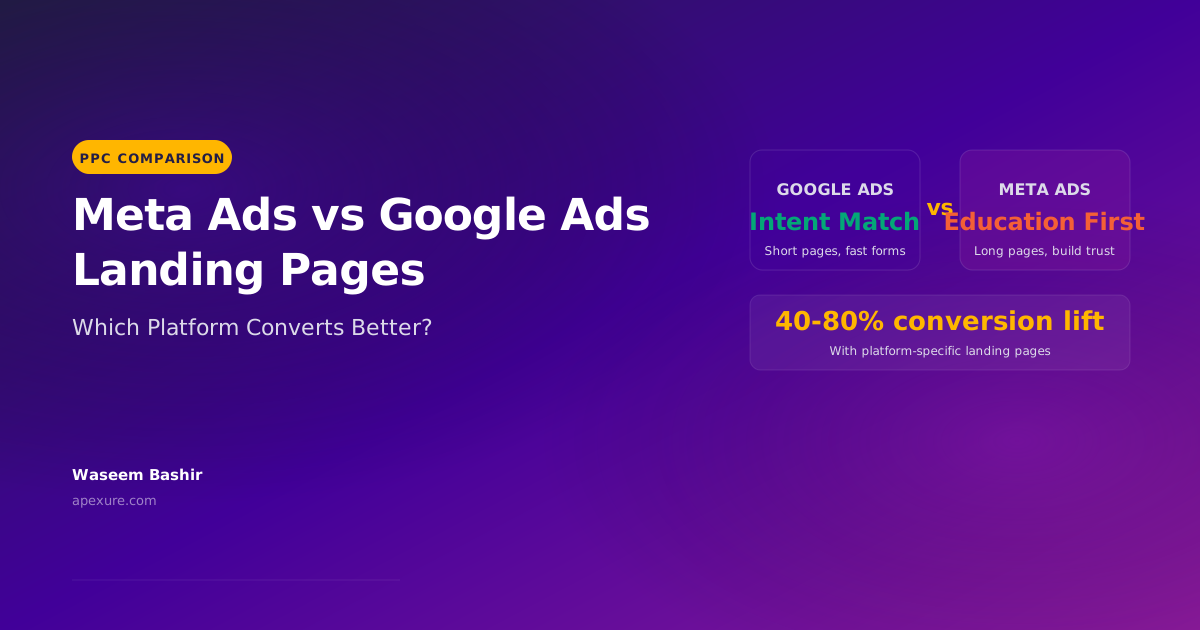
A B2B SaaS company spends $30,000 per month on Google Ads and Meta Ads. Both campaigns drive traffic...
Get quality posts covering insights into Conversion Rate Optimisation, Landing Pages and great design